
Gaming: The Final Barrier Falls
For years, many people stayed on Windows for one reason: games. If you wanted to play the latest blockbusters, Linux was often out of the question. You were forced to put up with Windows just to keep your hobby alive.
That era is over.
The Steam Revolution Thanks to Valve and their work on the Steam Deck, the “gaming gap” has closed. You can now play thousands of popular titles on Linux just as easily as you do on Windows. You click “Install,” you click “Play,” and it just works. In many cases, games actually run smoother because Linux isn’t fighting you for system resources in the background.
Note: There are still exceptions—specifically games that use “kernel-level” anti-cheat mechanisms. These currently will not work.
The Modern Hardware Crisis: Why Switch Now?
While gaming has made it possible to leave Windows, the current tech climate is making it necessary. We are seeing two major shifts that make Linux the smarter choice for your wallet:
1. The “AI Tax” on Components In 2025, the AI boom has sent the cost of computer parts—especially RAM—skyrocketing. Because data centers are buying up global memory supplies, the price for a simple RAM upgrade has doubled or even tripled in some regions. You shouldn’t be forced to buy a new, expensive PC just because your current operating system has become too “heavy” to run on your existing memory.
2. Windows 11 Abandoning Good Hardware Microsoft’s strict hardware requirements have “retired” millions of perfectly functional PCs. If your computer doesn’t meet their specific CPU or security chips requirements, they expect you to throw it away. Linux doesn’t believe in forced obsolescence. It can breathe new life into older hardware, making a “legacy” laptop feel as snappy as the day you bought it.
Why Microsoft is Pushing Users Away
Beyond the hardware costs, Windows has shifted from a neutral tool to a data-collection center:
-
Invasive “AI” Tracking: New features like Copilot and “Recall” are designed to watch what you do by taking constant snapshots of your screen. For many, this is a step too far for privacy.
-
Ads in Your Workspace: Your Start Menu and lock screen are increasingly used to sell you apps and services you didn’t ask for.
-
Forced Updates: Linux gives you back control. No more surprise restarts in the middle of a project because the OS decided it was time to update.
The Numbers Don’t Lie
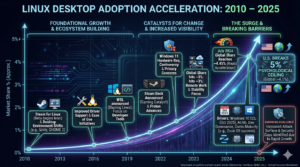 Because of these frustrations, Linux adoption is accelerating, recently hitting a milestone of 4% global market share. While it’s still the underdog, the growth is faster than ever. People are tired of being the product, and they are moving to a platform that treats them like an owner.